Communicators Warned of Rising Cyber Risks as IPR and CSA Hold Digital Safety Session
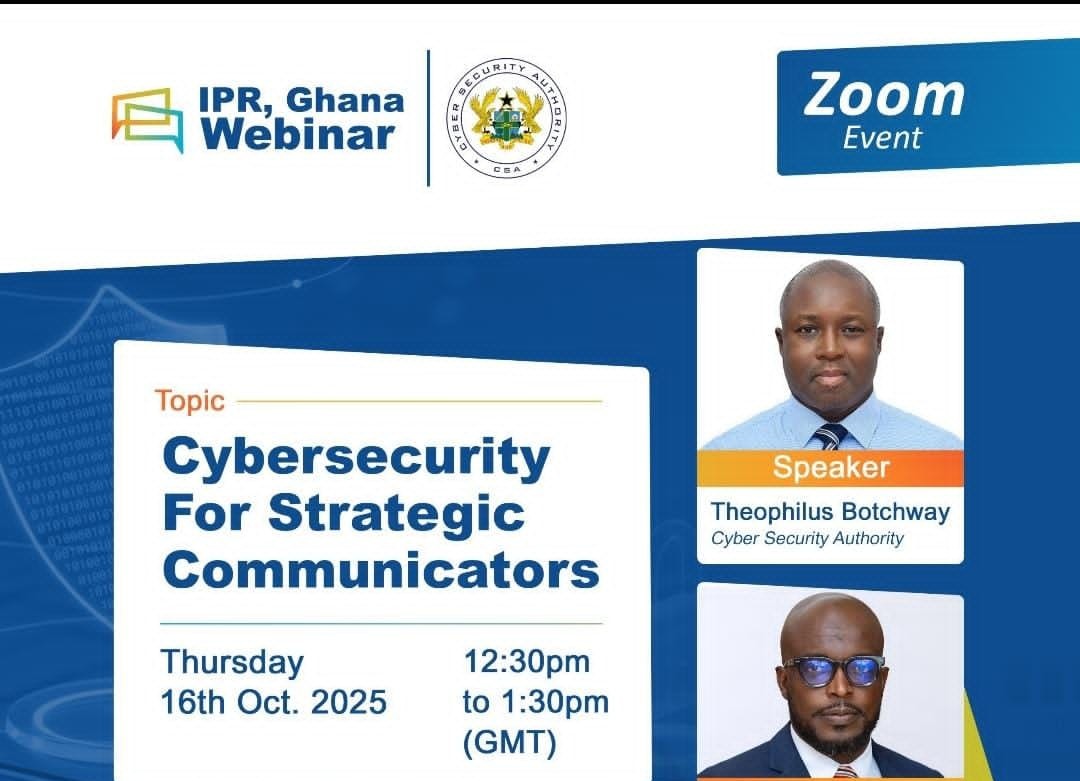 Cybersecurity experts have noted that communicators are now prime targets in the digital threat landscape, as the Institute of Public Relations Ghana (IPR-Ghana) collaborated with the CSA to host a symposium to educate practitioners on how cyber incidents have harmed brands and public trust.
The virtual session reflected growing concern within the communication profession over the scale and speed of cyber risks.
Opening the session, the moderator, Mr Nasir A. Yartey, noted that in today’s connected environment, a single compromised account or misleading post could instantly escalate into a reputational crisis.
Taking his turn, the Vice President of IPR, Mr Donald Gerald, stressed that cybersecurity was now a core professional duty for communicators. He explained that practitioners were not only the public voice of their organisations but also the first line of defence when misinformation or digital attacks threatened credibility.
The keynote presentation was delivered by Mr Theophilus Botchwey from CSA, who underscored the power and danger of misinformation. He spoke about how a fake “verified” Twitter account impersonating pharmaceutical company Eli Lilly falsely announced that insulin was free. The post went viral, wiped billions off the company’s value and forced a global apology campaign. He said the incident demonstrated how easily identity systems could be exploited and how quickly public trust could collapse when verification safeguards failed.
He outlined the major risks facing communicators, including phishing emails cloned to appear as internal instructions, malware embedded in promotional materials, impersonation attacks on social media, and business email compromise campaigns that mimicked senior executives.
Mr Botchwey advised the public to secure their accounts with multi-factor authentication, avoid using free public Wi-Fi for official communication, and rely on secure institutional email platforms. He urged communicators to limit access to organisational accounts, verify all sensitive requests directly with senders, and use Virtual Private Network (VPN) protection when remote.
He further stressed the need for cyber crisis communication plans, noting that organisations often scramble during incidents because communicators do not have pre-approved templates or escalation procedures and that outdated stories or fake content frequently resurfaced online, and urged communicators to fact-check thoroughly to avoid amplifying misinformation.
Participants were introduced to common attack methods such as malware infections from unsafe downloads, man-in-the-middle attacks on unsecured networks, and phishing schemes that tricked staff into revealing login credentials. Business email compromise, he noted, remained one of the most financially damaging threats because attackers mimicked legitimate email formats with small character changes, such as replacing an “o” with a zero.
Social Media Links
Events and Gallery

Advisories
Government Advisory
Business Advisories
Public Advisories
Children Advisories
